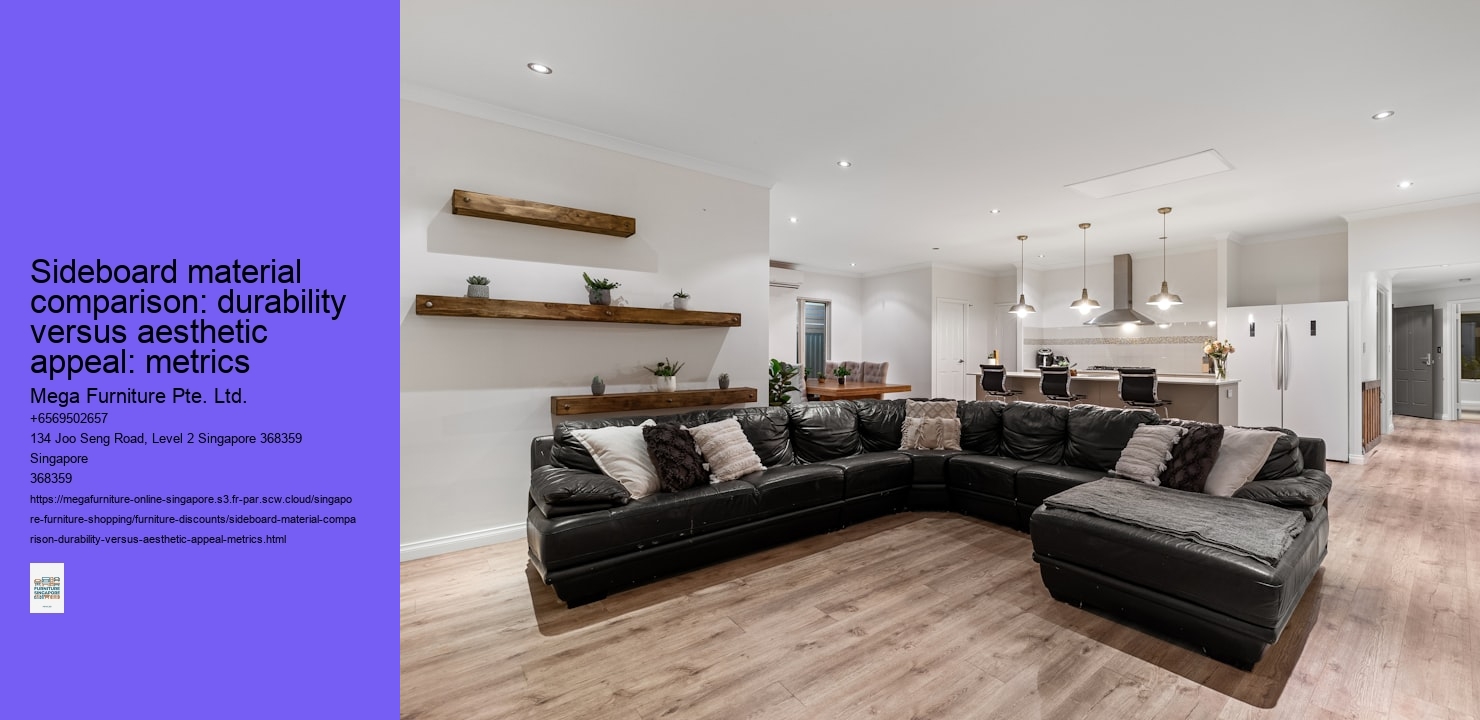
The sideboard in a 4-room BTO often ends up wedged against a narrow 3-metre wall, its proportions fighting the room’s from the start. It’s a common spatial puzzle: newer HDB layouts favour longer, narrower living rooms, leaving that key wall segment tight for anything deeper than 45 centimetres. A buyer here needs a piece that’s more vertical organiser than horizontal display—closed cabinets to hide router boxes and board games, with perhaps a slim top for a decorative lamp. The priority is containment, not grandeur. Contrast that with a 5-room resale flat from the 1990s, where the living room frequently presents a generous, uninterrupted feature wall. That expanse invites a longer, lower sideboard, one that can anchor a gallery of family photos or a curated collection of ceramics without feeling cramped. Function shifts towards display and complementing the room’s scale; you’ll see homeowners opting for sideboards with integrated lighting or open shelving to break up the mass. It’s a different calculation altogether. Condominium living rooms, particularly in compact new launches, demand even more strategic concealment. Storage here is premium, and a sideboard often doubles as the primary media console or a bar cabinet. The choice leans towards multifunctional designs with cable management, soft-close drawers, and finishes that resist humidity—think sintered stone tops over more porous materials. Every cubic centimetre must justify its place. Landed property interiors, with their typically larger footprints and formal entertaining spaces, treat the sideboard as a statement. It’s less about hiding clutter and more about presenting a curated aesthetic, often acting as a buffet during gatherings. Proportions are bolder, materials like solid rubberwood or full-grain leather inserts are common, and the piece is expected to hold its own in a room with higher ceilings. The need for discreet storage isn’t gone, but it’s gracefully integrated behind quality cabinetry. For those navigating these distinct needs, browsing a comprehensive
living room furniture collectioncan clarify how dimensions and functions align with your specific walls.
For durability, the hardness of a material like solid oak or laminate is key. These surfaces resist scratches from daily objects like remote controls or decorative items. This metric directly impacts longevity, reducing visible wear over years of use in a busy living room. Choosing a harder material prioritizes long-term structural integrity over certain delicate aesthetics.
The real test for a sideboard in a Singapore home isn’t the first year—it’s the third, when the daily 80% humidity has had time to work its way into every seam. Under continuous air-con, which dries the air, or the natural ventilation cycles of a landed property, materials react differently, and the failures are specific: a bowed door, a peeling edge, a musty smell from a damp corner.
Solid wood, like rubberwood or oak, is a traditional favourite for its heft and grain. It breathes with the humidity, which means it can warp if the piece isn’t properly acclimatised or sealed; you’ll often see this as a drawer that sticks in the wetter months of November and December. Engineered wood, with its plywood or MDF core and wood veneer, offers more dimensional stability against warping, but that thin veneer layer is the weak point—once moisture gets in at a joint, it can bubble and peel irreparably. For the laminate commonly used in more affordable options, the plasticised surface itself won’t warp or mould, but the particleboard substrate inside is a sponge; any chip or unsealed joint is an invitation for moisture ingress that leads to swelling, usually at the bottom edges where cleaning moisture gathers.
Metal frames or legs, typically powder-coated steel or aluminium, are functionally inert in our climate and won’t warp or foster mould. The risk is condensation and rust at weld points or screw holes, especially in perpetually damp service yards or if placed directly under an air-con vent. Practical checks are straightforward: run your finger along the inside of panel joints and look for any gap or raised edge, and inspect the underside of the piece for a complete, unbroken sealant or laminate layer—that’s where water vapour pools.
Anecdotal lifespans here diverge sharply. A solid teak sideboard in a naturally ventilated terrace house might last decades with only patina changes, while a poorly constructed laminate unit in a humid, air-con-free HDB common room can show swelling in under two years. The consensus from local workshops is that construction often matters more than the material category; a tightly sealed, fully laminated carcase with robust joinery will typically outlast a solid wood piece with unfinished undersides, regardless of the price tag.
That teak sideboard's warmth against a grey laminate floor isn't just an Instagram moment—it's a calculated signal of cohesion for future home viewings. In many BTO living rooms with Scandinavian-inspired palettes, natural wood grain provides a necessary textural counterpoint to cool whites and concrete-look tiles. A buyer walking into a Jurong West condo sees this harmony immediately; the piece feels intentional, not just placed. It suggests an owner who invested in layered design, which subtly elevates the perceived value of the entire space. That's a stronger impression than a room of mismatched, flat-pack items, however functional they might be.
A high-gloss lacquered MDF piece can look striking in a minimalist Tampines condo, but it might feel alien in a heritage Joo Chiat shophouse. The finish communicates the home's overall maintenance level and design era. Matte and satin finishes typically wear better in high-traffic family areas, showing fewer fingerprints than their glossy counterparts, which is a practical note future buyers appreciate. For resale, a finish that complements common HDB cabinetry—often laminate or wood veneer—avoids visual clashes that can make a room feel disjointed. It's about continuity, not just standalone statement.
Neutral-toned sideboards in oak, walnut, or white are safe, but they're safe for a reason—they photograph well for listing portals and appeal to the broadest buyer base. A bold, navy blue console might anchor your Aljunied apartment's scheme perfectly, but it becomes a distracting variable for a viewer imagining their own furniture. The most resilient palettes work with, not against, the common backdrop of developer-supplied tiles and walls. Think of it as choosing a centrepiece that won't force the next owner into an immediate repaint; that's a hidden value add they'll sense.
Solid wood joinery, weighty drawer slides, and consistent veneer alignment are silent ambassadors for a home's overall care. During a viewing, a prospective buyer will unconsciously test a drawer's movement; a smooth, quiet close suggests durability, while a wobble hints at impending replacement. These tactile details often matter more than the material alone in shaping a buyer's offer. They translate a style choice into an asset, implying the rest of the home has been maintained with similar attention. It's a non-verbal cue that carries surprising weight.
The final test is how the piece sits within the room's complete narrative. A sideboard shouldn't look like a stranded island but should connect to the lighting, rug texture, and even the artwork above it. This integrated look is what stylists achieve for show flats, and it directly influences valuation because it makes the space feel 'complete'. A future buyer in a Sengkang BTO isn't just buying square metres; they're buying a vision of a lived-in, cohesive home. Your furniture choices, therefore, become part of the property's sellable story, not just its contents.
The most expensive sideboard you'll ever buy is the one that doesn't fit past your BTO's main door. Delivery teams at Eunos or Bedok MRT-adjacent blocks routinely face the 110cm-wide lift lobby bottleneck; a unit that's 105cm wide might as well be a wall. Buyers fixate on price per piece, but a sideboard that lasts four years before warping costs more annually than a solid rubberwood one that'll survive a decade in Singapore's humidity.
Material choice often follows the wrong logic. High-gloss acrylic finishes look stunning in a Tampines showroom, but in a household with a shedding corgi or an inquisitive cat, they become a permanent gallery of scratches and paw prints. That matte laminate or textured oak veneer might seem less dramatic, but it'll look the same in three years — which is the point.
Underestimating storage is a classic error, especially with modern media setups. A sideboard needs to swallow not just table linens, but the black box jungle of a router, fibre modem, game console, and their attendant cables. The sleek, low-profile design you loved often has one shallow drawer and a cavernous, useless cavity behind doors; you'll end up with a tangle of peripherals on your living room floor.
There's a tendency to organise a living room for the photo, not for the Tuesday evening. You might not think you need closed storage until you're staring at a pile of board games and charging bricks. A sideboard with a mix of drawers for small items and full-height cabinets for bulkier things typically works better in a 4-room BTO layout than a uniform series of shelves. It’s less about the aesthetic statement and more about containing the inevitable clutter of daily life.
A glossy brochure might promise solid wood construction, but the reality often reveals itself in the drawer joinery. Dovetail joints—interlocking wedges of wood—are a clear sign of quality; they distribute weight evenly and won’t pull apart over years of use. Stapled or glued drawer bottoms, however, are a different story—they’re prone to sagging under the weight of dinnerware in a 4-room BTO, and you’ll hear that telltale creak every time you slide it open.
Heft matters, too. A well-built sideboard should feel substantial when you push it from the side in the showroom; that weight typically comes from a thicker backing board and proper internal framing, which prevents the entire unit from wobbling against your living room wall. Ask directly about the backing material—many budget options use a thin, veneered panel that bows over time, especially if you’re leaning a television against it.
Singapore’s humidity is relentless, and it doesn’t just affect your skin. Request the humidity-rated material certificates for any wood-based piece; these documents confirm the timber has been kiln-dried to a specific moisture content, around 8–12%, which drastically reduces the risk of warping or cracking in a north-facing HDB living room. It’s a simple request that separates suppliers who understand our climate from those who are just shipping in stock.
Finally, move the piece under different showroom lights. A uniform finish under harsh overhead LEDs might reveal subtle colour variations or patchy lacquer when viewed in the softer, diffused light of your actual space. That slight sheen difference won’t matter on a sales floor, but it’ll catch your eye every afternoon in an Aljunied flat.
A sideboard arriving three weeks before your BTO move-in date becomes a logistical headache, not a solution. Lead times for delivery must align precisely with your renovation schedule; a piece sitting in a warehouse for months while you wait for flooring to be installed is a common frustration, but it’s often unavoidable with imported items. Local retailers can sometimes offer more flexible scheduling, but you’ll still need to coordinate with your contractor’s final handover date—that narrow window when the floors are clean but the walls are still bare.
Assembly itself presents a distinct challenge depending on your access. For a walk-up flat, the delivery team will typically carry the disassembled cabinet to your door, leaving you to piece it together inside the living room. A lift-landing home, however, often allows for pre-assembly in the truck bay or corridor before final placement, which can be a significant advantage for larger, heavier units. The difference isn’t just about convenience; a poorly assembled sideboard on a uneven HDB floor can lead to persistent wobbling or misaligned drawers.
Warranties here are frequently tested by humidity. Most cover structural defects like joint failure or veneer peeling for a standard period, but they’ll explicitly exclude ‘environmental damage’—a category that often encompasses mould, warping from sustained moisture, or finish discolouration in a constantly humid living room. That’s a crucial exclusion for a piece placed near a balcony or in a poorly ventilated space. Post-assembly touch-up services, for scratches or nicks incurred during installation, are a valuable but inconsistently offered perk; some providers include a follow-up visit within a fortnight, while others treat it as a separate, chargeable repair.
You’re left navigating a series of practical compromises. The ideal sideboard might boast solid wood construction, but its six-week lead time doesn’t fit your BTO timeline. A quicker, flat-pack alternative saves on delivery hassle but demands your own assembly time on a Sunday afternoon. And while that sleek, laminated finish looks impeccable on delivery day, its warranty won’t cover the inevitable bloom of moisture marks if your living room lacks an air conditioner. The logistics, in many ways, dictate the final choice more than the aesthetics do.
A homeowner in a Bedok corner flat with a balcony-facing living room asked if her new sideboard would survive the humidity. She’d read builder reviews warning that even sealed wood can warp after a year of Singapore’s afternoon storms. The answer, drawn from local experiences, is cautious: a sideboard can withstand adjacency if it’s not directly exposed to rain and you choose a material that’s built for it. Laminate, with its resin-bonded surface, typically fares better against the moisture than solid wood, which can swell at the joints over time. That doesn’t mean you should avoid wood entirely — it just means you’ll need to check the finish and sealant, and maybe accept that an east-facing piece will require more maintenance.
Laminate or solid wood for an east-facing room receiving direct morning sun? Laminate resists fading better; its colour layer is protected by a clear wear layer that deflects UV rays. Solid wood, especially lighter tones like oak or ash, will patina and darken — a change some owners welcome as character, others see as damage. The trade-off is tactile. Laminate feels cool and uniform; solid wood has grain and warmth. In many homes, the decision hinges on whether you treat the sideboard as a utilitarian storage box or a centrepiece you want to feel like furniture.
Standard height to match an existing TV console is a practical puzzle. Most consoles sit around 45cm to 50cm high, designed for screen eye-line. Sideboards, being deeper storage units, often run taller at 70cm to 80cm. Trying to force them to match can look awkward — like a mismatched pair of shelves. Instead, consider treating them as separate but complementary elements: a lower console for the tech, a taller sideboard for the crockery and linens. That layered look often works better in a 4-room BTO layout than a rigid, symmetrical lineup.
Hiding cat scratching posts is a specific, beloved dilemma. The sideboard becomes a shield. Buyers report success with models that have solid side panels or recessed bases, creating a dark nook where the post can tuck in unseen. Avoid designs with open leg frames or floating silhouettes; they expose everything. One owner in a Tampines condo solved it by choosing a sideboard with a full plinth base and a textured laminate finish her cat ignored — the texture mattered more than the colour. It’s a reminder that in Singaporean homes, furniture often has a secret job beyond the one advertised.
The sideboard you've admired for weeks sits in a showroom at 50% humidity, but your fifth-floor HDB corridor flat in Bedok averages 78%—that's where the real test begins. Before you commit, apply a weighted framework: 60% to durability and structural integrity, 40% to aesthetics and finish. This split isn't arbitrary; it's the practical ratio for furniture that must survive Singapore's climate while still looking like a centrepiece in your living room. Start by mapping the piece's physical dimensions directly onto your floor plan, then cross-reference with historical humidity data for your estate from the NEA website. A rubberwood sideboard might be fine for a centrally air-conditioned condominium in Tanah Merah, but solid wood in a naturally ventilated ground-floor shophouse in Joo Chiat is a different proposition altogether. The goal is to avoid the slow warping of drawer fronts or the bloom of white mould along the back panel—common failures that aesthetics can't compensate for. Your final step should be a planned showroom visit with a specific mission. Bring the exact measurements of the allocated wall space, including skirting board height and power point locations, and have photos of your room's lighting and existing colour palette on your phone. Don't just glance at the finish; inspect the joinery at the back, test the drawer glide weight, and ask about the sealing process for the material. This is where a 180cm wide storage unit shifts from a catalogue image to a tangible object that either fits your space and life or doesn't. That planned visit is also your chance to see the full
living room collectionin person, assessing how your chosen sideboard's lines and finish might pair with a future coffee table or media console. Take a sample if possible, and observe how it looks under both warm LED downlights and the afternoon glare from your balcony—colours can shift dramatically. What looks like a stately grey oak in the showroom can read as cold and blue in a north-facing room.