A four-room BTO living room’s 3.2-metre width means a coffee table over 1.2 metres long starts to feel like a permanent obstacle course. In contrast, a Sentosa Cove living area can swallow that same piece whole, leaving vast, empty floor space around it—which is precisely why scaled-down ‘apartment-sized’ designs look lost and temporary in a bungalow’s expanse. The first, often overlooked, cost of a mismatched table isn’t the price tag; it’s the perpetual nuisance of shimmying past it or the visual cheapness of a tiny island adrift in a sea of tiles.
Material selection here is non-negotiable, dictated by the climate. Singapore’s 80% humidity year-round will test any surface, but the real test happens in enclosed, air-conditioned spaces where condensation cycles encourage mould along seams and underneath. That rustic, untreated solid wood table you loved in a showroom’s dry air will likely develop a fuzzy patina within a year in a north-facing room with less sun. Engineered wood veneers can delaminate at the edges, while powder-coated metal needs a flawless finish to resist spotting.
Practicality leans toward non-porous, stable materials. Sintered stone or ceramic tops handle spills and humidity without a second thought, and sealed, kiln-dried teak or acacia offer a warmer look if maintained. The best bet for many homeowners is a design with clean lines and minimal joinery where moisture can gather—a single slab top on slender, raised legs, for instance, leaves air circulating underneath and simplifies cleaning. It’s a dry, functional logic that beats aesthetic whims every time in our climate.
For BTO owners, the calculation often includes storage; a buyer wants hidden space for remotes and magazines in a compact layout. In a landed property, the table’s role shifts toward a central sculptural object, its surface area more important than its volume. Getting this context wrong means living with a piece that constantly reminds you it doesn’t belong—either by barking your shins or by seeming to shrink further into the corner each time you walk in.
The first hairline crack in a coffee table's veneer often appears near the coast—around Bedok or Marine Parade—where the salt-laden humidity works its way into unsealed edges. It’s a quiet failure. Low-density particleboard, sheathed in a thin wood-grain film, simply can’t cope; the substrate swells, and the brittle veneer splits along the grain pattern, leaving a permanent white scar. That split isn’t just cosmetic—it’s an entry point for moisture that turns the core to soft, crumbling mush within a season or two. You’ll spot this risk in pieces where the edge banding feels rough or where the patterned laminate doesn’t wrap fully underneath the tabletop.
Solid wood isn’t an automatic fix, either. Rubberwood, a favourite for its affordability and sustainability, is particularly prone to movement if it hasn’t been properly seasoned. In a rush to meet demand, some suppliers skip the crucial kiln-drying stage; the wood retains a high moisture content that equilibrates disastrously in our climate. The result is a table that warps, twists, or develops gaps in its joinery within months of arriving in your Tampines condo. It’s a lesson in false economy—buyer pays for solid wood but gets an unstable geometry that cups away from a glass.
Your best signals are in the details. Run a finger along every edge and corner; they should be completely sealed, smooth, and consistent. Examine the grain pattern on real wood surfaces—it should flow logically across panels and match at the seams, indicating care in material selection and cutting. For veneers, a uniform, repetitive pattern often betrays a cheaper paper-thin layer, while a more varied, natural appearance suggests a thicker, more durable slice. Heft the piece, too; substantial weight typically correlates with denser core materials that resist humidity.
These material checks matter more than a trendy finish. A well-constructed table in a simple oak veneer will outlast a poorly made one in the latest matte black, simply because its construction acknowledges Singapore’s environment. It’s about reading the object, not the listing. For those comparing options, focusing on these tangible indicators can filter out future problems before they ever leave the showroom floor.
A 1.5-metre coffee table in a 12 sqm HDB living room isn't just dominant—it's obstructive. That leaves barely half a metre for circulation on either side, forcing residents to shuffle sideways between sofa and table. You'll block access to built-in sockets and create a permanent shin hazard in a space that should feel open. Many buyers forget to account for the table's footprint with all chairs pulled out, which in a typical four-room BTO layout means the dining area gets compromised. It's a classic error of judging scale in an empty flat rather than a lived-in one.
Adjustable-height or lift-top coffee tables are popular for dual-use, but their mechanisms add significant heft. A solid wood lift-top can easily exceed 50kg, a fact often glossed over in online listings. That weight becomes a genuine concern for older HDB floor structures and a nightmare if you ever need to reposition it for cleaning. It also complicates delivery, especially for flats with narrow lift lobbies in estates like Bedok or Tampines. Buyers focused on function regularly ignore this physical reality until movers are huffing on their doorstep.
Ignoring scratch resistance with active pets or young children leads to rapid buyer's remorse. A high-gloss laminate or soft pine top will show every claw mark and toy car scrape within weeks. In many homes, a sintered stone or toughened glass surface isn't just a preference—it's a necessity for maintaining a decent appearance. The choice often boils down to a material that can withstand a corgi's zoomies or a cat's leap, which typically rules out many veneers and oiled finishes.
Failing to measure for leg clearance, particularly for floor fans or robot vacuums, renders a table's base design problematic. A solid plinth or low-hanging shelf might look sleek, but it will completely block airflow from a Dyson fan during Singapore's humid nights. That stylish, enclosed base also becomes a permanent dust trap and an obstacle for a Roomba, effectively creating two more chores. Smart buyers will look for tables with at least 15cm of open space underneath, a simple spec that's frequently overlooked.
The most common mistake is buying for the present layout without a thought for next year's refresh. A heavily styled, statement coffee table might suit your current grey sofa, but it'll clash horribly if you decide to switch to a tan leather suite. Singaporeans tend to update soft furnishings every few years, so a neutral, adaptable table base often proves wiser than chasing a fleeting trend. It's the difference between a centrepiece that lasts a decade and one you're trying to sell on Carousell in eighteen months.
The coffee table that looked perfect in the Tampines showroom often warps within a year in a Bedok flat, its surface turning cloudy from the relentless humidity. That’s the local condition most buyers forget until it’s too late. For a piece that sits through daily humidity spikes and the occasional spilled kopi-o, the finish isn’t just about aesthetics; it’s a functional barrier. Polyurethane finishes, with their hard, plastic-like coating, typically offer superior moisture resistance compared to traditional oil-based ones, which can feel warmer but require more frequent upkeep in our climate. A good polyurethane layer repels water rings and resists clouding, meaning your sintered stone or rubberwood tabletop keeps its look without constant vigilance.
Height is another silent mismatch, especially when pairing with a typical Singapore sofa. The standard seat height here falls between 42 and 45 centimetres; a table that’s too tall forces you to reach up awkwardly, while one that’s too low makes every retrieval a chore. It’s a simple measurement, but getting it wrong disrupts the entire living room’s ergonomics, turning a centrepiece into a daily nuisance. Always cross-check the table’s stated height against your own sofa’s dimensions—don’t assume they’ll align.
For the majority living in 4-room BTO flats or compact condos, a table’s footprint is only half the story. The real test is its flexibility when you need floor space for a yoga mat, a play area, or extra seating during gatherings. Foldable designs or nesting tables that tuck away become invaluable, transforming a fixed obstacle into a multi-use asset. A pair of nesting tables can be separated for distributed surface area, then stacked neatly by the TV console when not in use, a practical solution for a 12 sqm living room.
Material choice follows the same logic of resilience. While glass and high-gloss laminates can show every fingerprint and water spot, matte finishes on robust materials like engineered stone or treated solid wood handle the humid, high-use reality better. They hide smudges and withstand the condensation from cold drinks, which is a constant in our air-conditioned living rooms. It’s less about chasing a trendy look and more about selecting what won’t look tired after six months of Singaporean life.
Finally, consider the legs. A common pitfall is opting for a heavy, solid plinth base in a narrow space, which visually clutters the room and makes cleaning underneath impossible. Open, splayed legs or a central pedestal base create a sense of airiness and make it far easier to run a robot vacuum around—a small detail that contributes significantly to liveability in a tight floor plan.
The catalog shot of a walnut coffee table looks flawless, but that’s because the floor is level and the lighting is perfect. Singaporean homes, particularly in older HDB blocks or landed properties with renovated floors, rarely are. A slight warp in the timber or an imperfect joint that’s invisible online becomes a persistent wobble on your uneven living room tiles. That’s why a physical inspection isn't a luxury; it’s a basic diagnostic step for any piece that needs to sit flat. You can’t simulate the subtle slope of a Tampines condominium floor or the micro-vibrations from an MRT line passing near a Joo Seng flat through a product video. Visiting a showroom lets you perform simple, critical tests. Press down on opposite corners of a table to check for racking—a sign of weak joinery that will only worsen. Run your hand along the seams of a drawer or cabinet door; gaps or rough edges suggest cost-cutting in production that a glossy image will always hide. You’re assessing the actual object you might live with, not its idealised digital twin. This hands-on check is especially vital for solid wood pieces, where seasonal humidity in Singapore can cause movement that cheap fasteners can’t handle. Material interaction with light is another factor best judged in person. A high-gloss lacquer or a polished marble top in a showroom under Singapore’s intense ambient light will show you exactly how much glare to expect in your own space. That reflective surface might amplify the sense of space in a narrow 4-room BTO layout, or it could become an annoying source of glare opposite your television. Similarly, the true colour of a veneer or the texture of a linen-look laminate is often distorted by studio photography and your screen’s settings. Ultimately, a showroom visit shifts the decision from abstract dimensions and curated photos to tangible quality and environmental fit. You’re not just confirming a style choice; you’re conducting a pre-purchase audit on stability, finish, and practical harmony with your home’s specific conditions. It’s the most straightforward way to avoid the quiet disappointment of a piece that looks right in theory but feels wrong in practice. For a comprehensive look at pieces you can assess firsthand, browse the
living room collectionavailable for inspection.
A solid wood coffee table can survive a decade of humidity, but that warranty won’t help if the delivery team refuses to carry it up four flights of stairs. Logistics are the first hidden cost, especially in pre-1990 HDB blocks where lifts only stop at certain floors; confirm with the retailer that staircase delivery is included, not just kerbside drop-off, or you’ll be left coordinating movers from Bedok to Bukit Batok yourself.
Assembly seems straightforward until you’re missing the one bracket that matters. For landed properties with young children, insist the assembly service includes installing anti-tip fittings — those small metal anchors that secure a tall TV console or bookshelf to the wall are non-negotiable, yet they’re often treated as an optional extra. It’s a five-minute job that prevents a lifetime of regret.
Singapore’s climate is a permanent test for materials. A standard one-year warranty might cover manufacturing defects, but it typically excludes the slow warping of solid timber or the white haze that forms on laminated surfaces in consistently damp conditions. Look for explicit coverage for humidity-induced damage; without it, a table that looks perfect in an air-conditioned Tampines showroom can swell and crack within a monsoon season in your Pasir Ris flat.
That specificity extends to the entire living room set. When you’re coordinating delivery for multiple pieces — a coffee table, sideboards, perhaps a display cabinet — a single, scheduled installation day saves you from taking multiple days off work. Some retailers, like Megafurniture, can organise this through their showrooms, turning a logistical headache into a single afternoon’s project.
Ultimately, the finest sintered stone or rubberwood finish is irrelevant if the support framework fails. Read the warranty’s fine print on structural integrity for load-bearing joints, particularly for extendable tables or designs with cantilevered legs; that’s where cost-cutting in assembly or materials first becomes apparent, usually just after the return period ends.
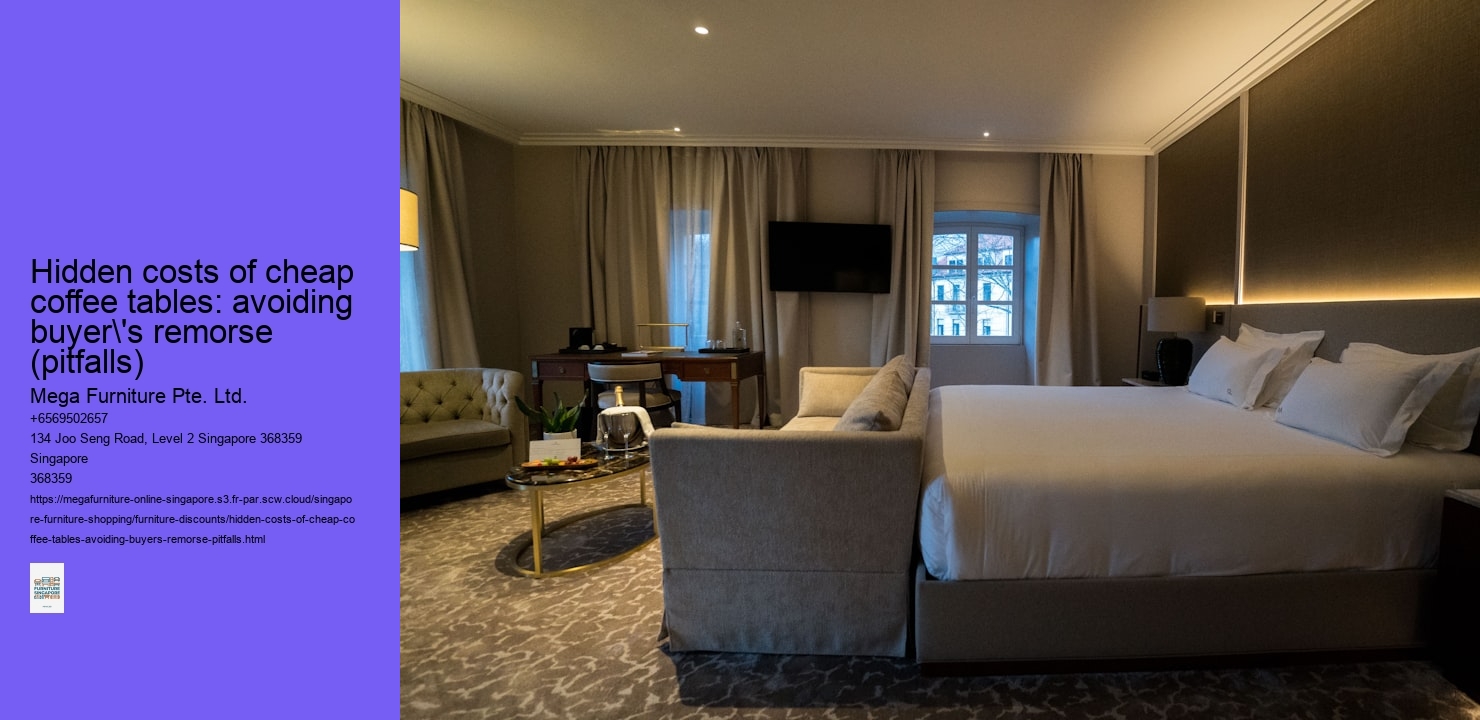
" width="100%" height="480">Hidden costs of cheap coffee tables: avoiding buyer's remorse (pitfalls)Many budget coffee tables use particleboard or hollow-core construction instead of solid wood. These materials are prone to warping, cracking, or collapsing under moderate weight over time. A table that wobbles or sags soon after purchase is a common sign of this hidden cost, leading to premature replacement.
The best questions about coffee tables come from buyers who’ve already measured their space and now face the daily realities of Singapore living. They’re past the aesthetics and are thinking about survival.
Can it withstand daily wet cloth cleaning? For a table in a home with kids, this is a daily ritual. Laminates and sintered stone handle it without complaint, while real wood or veneer needs a quick, dry follow-up to prevent moisture seepage and eventual warping. A sealed, lacquered finish offers more protection than an oiled one.
Is tempered glass suitable for condo living with kids? Tempered glass is safe—it crumbles, not shatters—but it’s a fingerprint magnet. You’ll be wiping it constantly, which some parents find a fair trade for the visual spaciousness it brings to a 4-room BTO living room. Just check the edges are polished smooth.
Does oak veneer fade under east-facing window sun? Any wood-toned surface will fade eventually. East-facing windows get intense morning light, so a veneer will show a colour shift over years; using blinds during peak hours is the only real mitigation. It’s a patina some welcome, but if you want uniform colour, look to laminates or stained solid wood.
How to secure a table during monsoon wind gusts? For landed homes or high-floor condos with balconies, a heavy stone or solid wood base is your best anchor. For lighter tables, consider discreet anti-slip pads under the feet or, in extreme cases, a furniture strap fixed to a wall stud—it’s an unsightly solution, but so is a glass top sliding across the room.
That last walk-through of your 4-room BTO layout, tape measure in hand, is often the moment a coffee table’s true scale reveals itself. You’ll want to confirm its footprint doesn’t choke the walkway to the balcony or sit too close to the TV console, leaving a cramped 60-centimetre gap that’s awkward for cleaning and feels hemmed in. Revisiting your measured floor plan—accounting for the swing of your main door and the reach of your ceiling fan remote—prevents that costly realisation after delivery.
Material certification matters just as much as dimensions in our climate. For any wood, laminate, or engineered stone surface, insist on documentation showing resistance to humidity levels above 75%; an untreated rubberwood tabletop can warp within a single monsoon season. This verification is non-negotiable if you’re pairing the table with a humidifier or live in a ground-floor unit near neighbourhoods like Bedok or Pasir Ris, where ambient moisture is persistently high.
Align the promised delivery timeline with your BTO key collection or renovation handover, but build in a buffer. A two-week delay might mean living with a table boxed in your hallway for a month. Before signing off, simulate daily use: place a heavy steaming pot of *bak kut teh* off-centre to test for wobble, or stack a laptop, hardcover books, and a gaming controller on one corner to check weight distribution. A table that deflects under a 10-kilogram load won’t survive family movie nights.
That final scrutiny of the joinery underneath—the gussets, screws, and leg attachments—often tells you more about longevity than any product description. It’s the unglamorous pre-purchase ritual that separates a lasting centrepiece from tomorrow’s bulky disposal headache.